
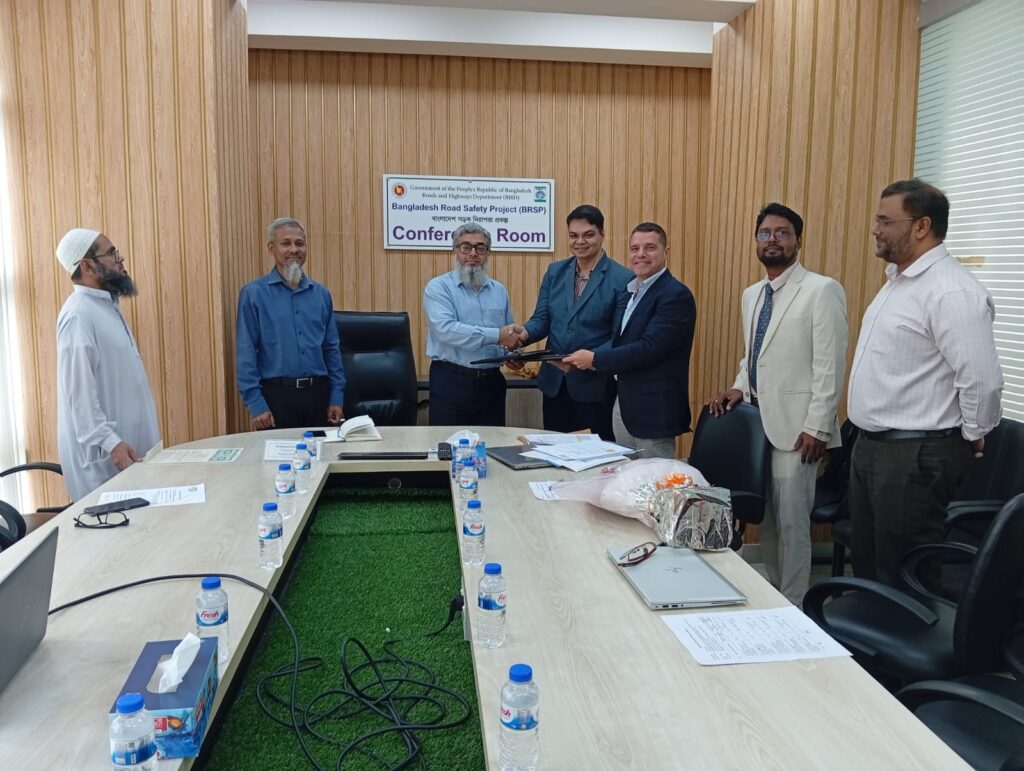
FRED Engineering is pleased to announce the signature of a new consulting contract in Dhaka for the Development of Technical Manuals for the Bangladesh Road Transport Authority (BRTA), part of the World Bank-financed Bangladesh Road Safety Project (BRSP).
Working in close coordination with BRTA, RHD, and the World Bank, FRED Engineering will deliver five core technical components aligned with international best practices:
-
-
National Traffic Signs Manual & Licensing System Review: Updating the national Traffic Signs Manual based on regional and international standards, alongside a comprehensive review of the driver licensing system under the Road Transport Law (2018) and Road Transport Rules (2022) and a new manual for non-commercial driver training.
-
Vehicle Inspection Manual & Policy Guidelines: Developing a detailed technical manual covering visual, automated, and emissions testing, pass/fail defect criteria, management guidelines, and a rollout plan for Vehicle Inspection Centers (VICs) across district and metropolitan areas.
-
Motorcycle Helmet Standards & Enforcement: Supporting BRTA and the Bangladesh Standards and Testing Institution (BSTI) in aligning national helmet specifications with international benchmarks (such as UNECE Regulation 22.05), complemented by enforcement protocols and public awareness guidance.
-
Commercial Driver & Bystander Training: Reviewing existing commercial training schemes and designing a cohesive national curriculum—including gender sensitization and sexual harassment prevention and response modules for bus drivers, conductors, and enforcement officials.
-
Gender and Inclusion Strategy & Action Plan: Formulating an institutional strategy, a driving license gender toolkit, and inclusive public service vehicle design criteria to ensure safe, accessible mobility for women, persons with disabilities, and vulnerable road users.
-
This new assignment further consolidates FRED Engineering’s presence in South Asia and reinforces our commitment to supporting national transport authorities in translating global Safe System principles into practical, lasting institutional standards.